
The Default Communication System

Forty-five people gathered for dinner in our neighborhood last month. That’s actually not unusual. What was different this time is that every part of it was run by kids eighteen and under. They organized and planned it. They cooked. They served.

The kids built a whole cafe out of nothing, and it worked — the meal was delicious, the room was full, everyone left happy.
But I noticed something underneath the success. The miscommunications that happened, and there were a few, didn’t happen randomly. They happened in a pattern.
The kids who already texted each other, who already had each other’s numbers, who already hung out — they communicated fine. The ones who didn’t already have that ease with each other? That’s where things fell through.
Nobody assigned that. Nobody decided the kids with existing friendships would be the ones who stayed in the loop. It just happened. A system formed on its own, built entirely out of who already found it easy to reach out to whom.
I don’t think the kids saw what I saw. But I recognized it instantly, because I see it constantly in organizations.
Communication Systems
Every organization and team has a communication system. The question is whether anyone designed it, or whether it just happened.
You might have regular staff meetings, email systems, a slack or teams channel for chatting. Having these formal communication methods doesn’t mean the real work gets done there.
That’s because the people with an easy rapport are more likely to communicate. We’re more likely to talk with someone who’s easy to text with or call. We tend to have more open dialogue with the person we stop by to say hello to without thinking twice. The individuals who routinely go out to happy hour together will discuss work while there.
Meanwhile the input from others that’s needed gets overlooked in these informal channels.
Decisions happen. Commitments get made. And whoever wasn’t part of that ease finds out after the fact, if they find out at all.

The Awkwardness of Good Intentions
As a community leader, I feel this dynamic at play too. There are people I reach out to easily.
They’re the ones I tend to confer with when I’m seeking advice. Or I’ll spontaneously run an idea by them because we’re catching up on the patio anyway.
The system I default to isn’t neutral. It’s built on ease, and ease isn’t the same thing as who actually needs to be talking to whom.
Oftentimes it takes intentional and conscious effort for me to loop the right people into the communication. An awkward walk to knock on a door I wouldn’t normally go to. Looking up a phone number for someone I’ve never called before.
There are times our email lists do the trick. I can send an email to a group and rest assured the right people are in the know. But not everything that needs to be communicated about can be relegated to an email. And it’s up to me to discern the difference, then make the effort to engage in the appropriate communication method for the situation, especially when it’s awkward or uncomfortable.
From Go Between to Line Holder
There's a difference between closing a gap and becoming the permanent bridge over it. I've watched what happens when leaders default to the second without meaning to.
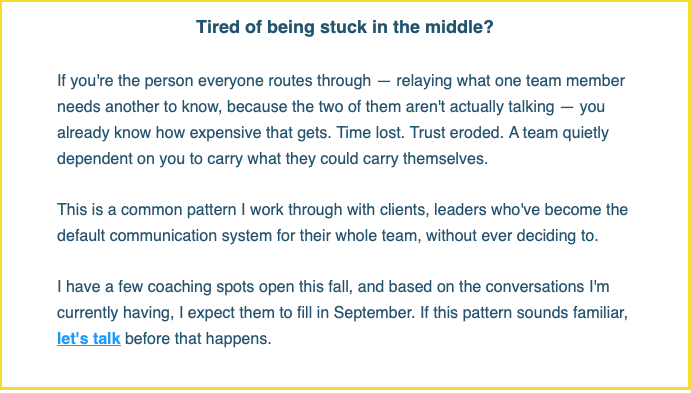
Someone becomes the go-between — relaying what one person needs another to know, because the two people who actually need to be talking aren’t. It feels helpful in the moment. It might even feel gratifying to be relied on and in the know.
But over time, this workaround gets expensive. Like the game of telephone, things get lost in translation. Time gets wasted. Trust erodes. And the team quietly becomes dependent on the point person to carry information that two people could have exchanged directly.
The shift isn’t about forcing friendship. It’s smaller than that, and harder, it’s about noticing when you’re the one closing a gap that shouldn’t need you in the middle, and asking instead of relaying.
I have a client who’s been cultivating this skill within himself so his team stops escalating issues to him they could solve amongst themselves. He’s used to being the fixer, but he doesn’t have time to be the go between and his team can’t afford the cost of not working together.
So he’s taking a multipronged approach. We’ve worked on changing how he responds in one-on-one conversations. Instead of trying to fix or relay messages, he asks questions and encourages direct communication between the parties involved.
Together, we have provided training and support to cultivate trust and develop the communication skills of his team. These skill building experiences happen through targeted training where real problems are being addressed while practicing new tools. He also brings team building experiences into routine staff meetings to nurture trust and connection. This has the added benefit of keeping the communications concepts from the trainings alive while ensuring meetings are more than just transactional exchanges of information.
And he continuously reinforces the expectation that conflicts, misunderstandings and miscommunications are dealt with directly. If someone avoids having a hard conversation with another colleague he will coach them through it. If that’s not enough, he will either offer to be present or hire me as a mediator. Overall, he’s deeply focused on equipping his team with the resources and support to communicate effectively.
Setting clear expectations for direct communication might be a hard line for the perpetual people pleaser and fixer to hold. But when the expectation is consistently enforced and support is provided for people to develop the lagging skills holding them back, I’ve seen morale and productivity improve in ways that positively impact the bottom line.

Challenge Accepted
The kids’ dinner will stay a sweet memory for a lot of people, including me. It was also a clear look at something I see everywhere: a default communication system quietly undermining the work until someone decides to notice and do something about it.
More often than not, conflict rooted in miscommunication feels like an insurmountable obstacle in our minds. What it actually calls for is intentional, direct, candid, and kind communication.
It might feel awkward at first. It may take more time than defaulting to business as usual. It can feel like an uphill battle getting people, including yourself, to change the habits that feel easiest.
And building communication practices that ensure the right people are having the necessary conversations isn't just about saving time, money, and energy, though it will. It's about staying in integrity with what you actually believe — that we can accomplish more when we work better together, that inclusion isn't optional, and that collaboration is worth the discomfort it takes to build it.
What communication system are you currently operating inside of?Does it foster inclusion and direct communication?If not, what steps will you take to ensure the right people are looped in?


Comments