
It’s Okay to Fail: What 2017 Taught Me About Falling Apart—and Finding My Way Back

Some years start with crisp plans and fresh notebooks…and end with a pile of should’ves. Mine did. In 2017, right after publishing A Misfit Entrepreneur’s Guide to Building a Business Your Way, I mapped bold programs and growth goals. I was energized, clear, and ready.
And then I wasn’t.

A wave of unprocessed, complex trauma pulled me under. Tasks that used to be simple, sending a newsletter, attending a networking event, pitching a perspective client, felt like climbing a cliff without gear.
My plans slipped. My goals went unmet. I told myself, “You’re a failure.” For a while, I believed it.
This is the story of how I learned that failing doesn’t make you a failure and why that shift matters for how we plan the year ahead.
When Plans Don’t Survive the Year
Leading up to 2017, I’d spent years studying business. I learned lean startup, marketing, websites, content creation, sales, financial management, business development, the whole gambit. What I hadn’t tended to was me.
When my nervous system hit its limit, the “doing” side of business outpaced the “being” side. I could recite best practices, yet everyday actions felt like boulders.
If you’ve ever stared at a simple task and felt inexplicably stuck, you’re not alone. It’s not laziness. It’s data from your body saying, “I’m out of resources.” Pausing to understand yourself isn’t indulgence; it’s maintenance.
Hard ≠ Wrong
There’s a narrative out there that says, “If it’s hard, you’re doing it wrong.” I don’t buy it.
Hatching birds need the struggle of breaking their eggs to build the muscles to fly. Humans aren’t that different. The work of breaking out of habits, patterns, and old stories, is hard, and that difficulty is part of how we grow capacity.
What helped me wasn’t forcing productivity; it was building regulation and response: notice what’s happening, name it accurately, then navigate with intention. That three-step rhythm is simple, not easy - and it works across parenting, partnership, and leadership.

Reframing Failure
Fast-forward to the close of 2025. As I reflect on this year, I’ve noticed dynamic shifts in the marketplace that have affected my business. Put simply, developing new opportunities takes longer and more persistence than ever before in my 14 years in business - things tend to move at a glacial pace.
For a while, I read the slow cycle as a failing. Now I treat it as a reality to design for - nurture long games on purpose, diversify the pipeline, and build financial and emotional buffers so slow doesn’t equal scary.
If you’re in a start–stop year, you’re in good company. Many teams are managing sputtering funding, budget cuts, shifting timelines and unclear change initiatives. That’s not a verdict on your worth; it’s context to plan around.
What Actually Helped
Here’s the truth: I didn’t muscle my way out of the pit of 2017. I re-built from the inside out.
These practices are the ones I return to when I’m tempted to label myself a failure.
1) Center the human in the plan
When I finally admitted that adrenaline had become my operating system, I stopped letting what everyone else does set my expectations. I asked what I needed to be resourced enough to lead - more time for things that bring me joy, space to live and learn from my experiences, and permission to say no to well meaning advice from others that didn’t fit my capacity. That shift didn’t just feel kinder; it made follow-through possible.
Why it matters: Strategies only run at the speed of the person leading them. When you center the human, you get sustainable progress instead of surge–crash cycles.
2) Co-regulate with community
In the darkest stretch, I chose not to white-knuckle it alone. Letting trusted people hold me, with compassion and gentle nudges, shined light on the fear and helped me learn to trust myself again. Support didn’t erase the hard; it made the hard survivable.
Why it matters: Isolation distorts data. Community restores perspective and capacity so you can keep moving without bypassing what’s real.
3) Show myself compassion → shift from urgency to calm productivity
Urgency used to feel like virtue. Compassion became the off-ramp. By pausing, naming what’s true, and choosing a measured response, I rewrote the habit of constant reactivity. That’s what let me make hard choices and back long-term goals without chasing every shiny distraction.
Why it matters: Compassion turns runaway urgency into intentional action—so you can be responsive, not reactive, and stay with what matters.
4) Grieve, then go again
When the response to launches was crickets or momentum died, I stopped pretending I didn’t care (or let myself be utterly destroyed). I named the loss, let myself feel it (without fueling negativity), and then chose whether to repair or release. Grief cleared the fog so I could re-enter with integrity instead of defensiveness.
Why it matters: Untended grief leaks into urgency, defensiveness, and overwork. Honoring it gives you back choice, focus, and trust.
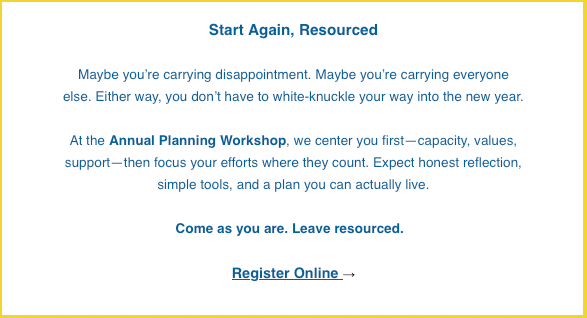
A Gentle Year-End Reset
Give yourself 15 unhurried minutes in the next few days. Sit down with your favorite hot beverage, open your journal, and let 2025 breathe on the page - no editing, no withholding.
Just you, your truth, and enough compassion to hold both the wins and the grief.
Set a time for 15 minutes and write reflections to these questions.
What surprised me this year (good and hard)?
What have I learned about myself this year?
What do I want to bring forward into 2026?
When the timer ends, close your notebook. Put a hand on your heart and show yourself some compassion - you’ve been through a lot and you’ve done your best. Then take the smallest next step you can to keep your reflections alive.
When pressure mounts, remember, you’re not behind. You’re on a human timeline.
Failing is Living
I’ve failed countless times and I will again. That’s not a confession; it’s proof I’m still taking shots. The goal isn’t to make life easy. It’s to become the kind of leader of teams, families, and ourselves who can meet hard seasons without abandoning what matters most.
If you’ve found value in what I wrote here and you want to support me in continuing to create, guide, write, and make space for deeper transformation, I invite you to buy me a tea.


Comments